


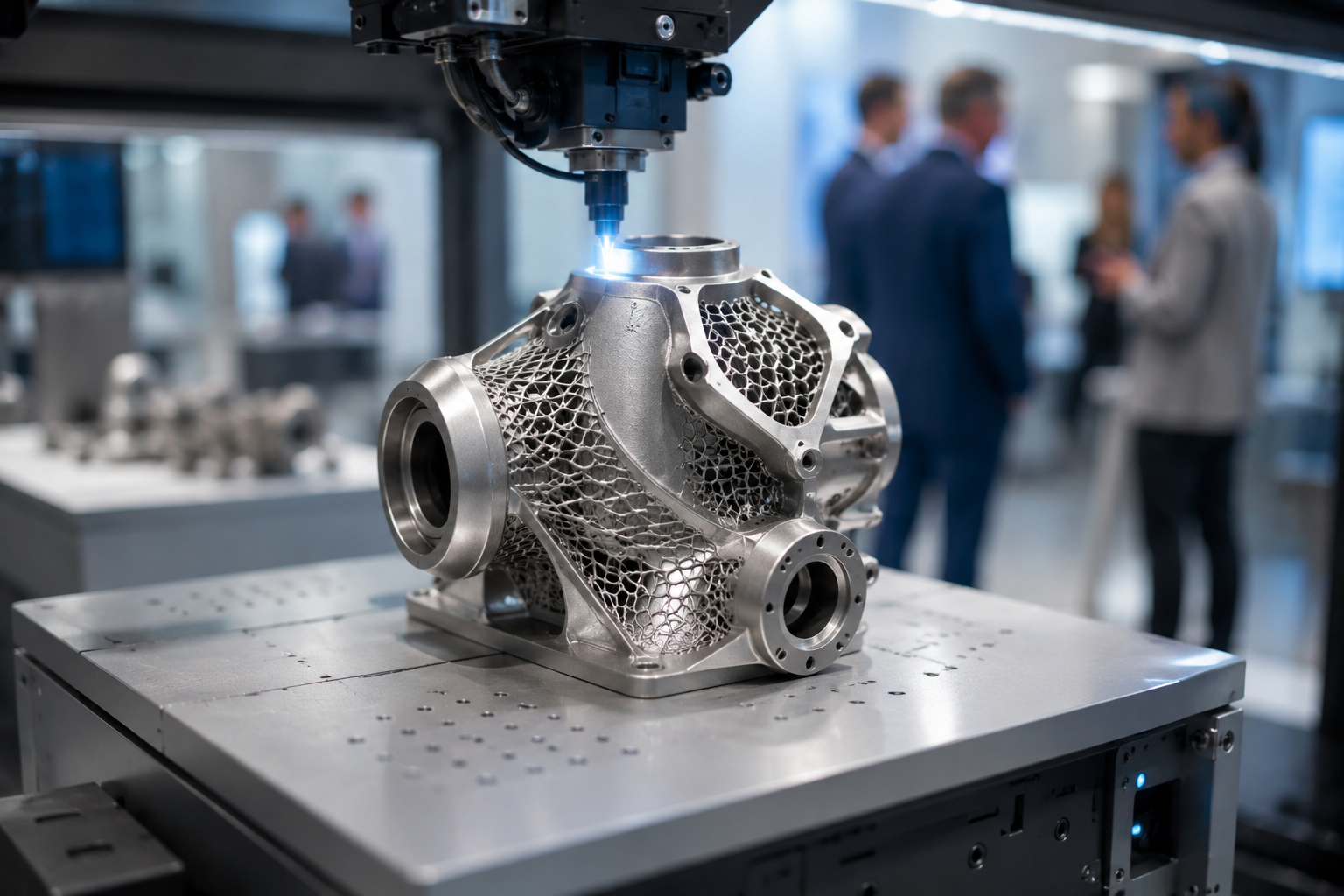
Additive manufacturing has quietly graduated from a prototyping curiosity to a genuine production technology, and the news cycle around it reflects that shift. Instead of headlines about novelty prints, the biggest stories right now involve aerospace giants opening dedicated production facilities, defense agencies testing manufacturing equipment aboard active naval vessels, and acquisitions consolidating fragmented parts of the industry into larger, more capable players. Here’s a rundown of what’s actually happening in additive manufacturing this month, and why it matters beyond the immediate headlines.
Aerospace Is Driving Serious Capital Investment
Rolls-Royce recently opened a new additive manufacturing development cell at its Defence Assembly and Operations facility in Bristol, UK, backed by funding from the UK Ministry of Defence. The facility, housed in a purpose-built space of nearly 3,800 square feet, is specifically engineered with tightly controlled humidity, temperature, and air pressure to ensure consistent quality when manufacturing critical engine components from metal superalloy powders using laser-based systems. The stated goal is producing parts for next-generation combat propulsion systems, and the facility is also being framed around efficiency gains — additive processes generally use exactly the material needed for a part, cutting down on the waste and energy consumption associated with traditional subtractive manufacturing.
This kind of investment isn’t an isolated move. It reflects a broader pattern where aerospace and defense have become the primary proving ground for additive manufacturing’s transition from prototyping tool to production-grade technology, precisely because these industries can justify the cost of rigorous qualification and certification processes that other sectors often can’t.
The Certification Question Is the Industry’s Real Frontier
A recurring theme across recent industry events is that additive manufacturing’s biggest remaining challenge isn’t really about whether the technology can produce good parts anymore — it’s whether those parts can be qualified, certified, and reliably repeated at scale in mission-critical applications. This exact framing shaped the agenda at Additive Manufacturing Advantage: Aerospace, Space and Defense 2026, an industry event that brought together speakers from organizations including NASA’s Marshall Space Flight Center, Safran, America Makes, and several metal AM equipment makers to specifically address qualification strategies, machine certification, and scaling production from prototype runs to full mission readiness.
That shift in emphasis, from “can this technology work” to “can this technology be trusted at scale,” is arguably the most important undercurrent in additive manufacturing news generally right now. It’s a less flashy story than a new printer launch, but it’s the one that will determine how quickly the technology moves from a supplementary tool into genuinely mainstream production across critical industries.
Defense Is Testing Manufacturing Where It’s Needed Most
One of the more unusual recent developments involves manufacturing equipment being deployed directly aboard an active naval vessel. As part of this year’s Rim of the Pacific maritime exercise, a containerized hybrid manufacturing system combining CNC machining with wire-laser metal deposition technology was deployed aboard the USS Essex to evaluate expeditionary production and repair capabilities in real operational conditions. The system is designed to let military personnel repair worn parts, produce new metal components, or perform precision machining much closer to where those parts are actually needed, rather than waiting on traditional, often slow, supply chains.
This kind of test matters well beyond its immediate military application. It represents one of the clearest real-world demonstrations of additive manufacturing’s core promise: producing parts on demand, near the point of use, rather than depending on centralized manufacturing and long-distance shipping. If systems like this prove reliable in genuinely austere operating conditions, the lessons learned tend to filter into civilian applications in remote or supply-constrained settings as well.
Consolidation Is Reshaping the Industrial Landscape
The additive manufacturing industry has also seen notable consolidation recently, with 3D Prod’s acquisition of Sculpteo bringing together industrial production capacity, finishing expertise, and a broad range of manufacturing technologies under one roof. The combined company is positioned to serve the full range of a customer’s needs, from rapid prototyping through one-off manufacturing to full industrial-scale production, and it’s targeting meaningful revenue growth over the next couple of years as it continues expanding across Europe and North America.
This kind of consolidation makes sense against the backdrop of a global 3D printing market valued at roughly $24 billion, which industry analysts expect to roughly double within the next five years. As the market grows, fragmented smaller players increasingly find that combining forces, whether through acquisition or partnership, gives them the scale needed to compete for larger industrial contracts that a single smaller company couldn’t credibly pursue alone.
New Equipment Is Targeting Continuous Production, Not Just Prototyping
Equipment launches this month have reinforced the industry’s shift toward production-focused hardware rather than prototyping tools. UltiMaker’s recently launched Factor 4 Plus platform is explicitly built for continuous factory production in manufacturing and aerospace settings, supporting applications like custom jigs and fixtures and durable spare parts made from high-performance, chemical-resistant composite materials. It also includes automated reporting and certification features aimed squarely at the traceability and quality-assurance requirements that critical production workflows demand — another sign of the industry’s overall shift toward being trusted for serious, repeatable manufacturing rather than one-off prototypes.
Funding Is Following Real Commercial Traction
Investment activity has also picked up meaningfully. Houston-based hypersonic startup Venus Aerospace recently closed a $91 million Series B funding round, a notable vote of confidence from investors in companies applying advanced manufacturing techniques to genuinely difficult aerospace engineering problems. Meanwhile, market analysts tracking additive manufacturing applications specifically within drone production estimate that segment alone could approach $900 million in value within the next several years, reflecting how additive techniques are increasingly being adopted for specialized, lower-volume production runs where traditional manufacturing methods don’t scale down cost-effectively.
Why All of This Matters Together
Individually, none of these stories — a new development facility, a shipboard manufacturing test, an acquisition, a new printer platform — sounds like it’s reshaping an entire industry. Together, they paint a fairly clear picture: additive manufacturing has moved decisively past its “interesting but experimental” phase and into a period defined by industrial-scale investment, real qualification and certification work, and serious capital following genuine commercial traction rather than novelty. For manufacturers evaluating whether to adopt or expand additive manufacturing in their own operations, that’s the most useful signal in today’s news cycle — not any single headline, but the consistent direction all of them are pointing.
